What’s Hot

Showing posts with label ethicalhacking. Show all posts
Friends are you always worried about your Presence on Social Media's ? Are you always Lacking in getting Likes on your Status and Pics ? Do you Just have 10-15 Followers on Facebook ? Do you want Thousands of Facebook Followers or Thousands of Likes on your Facebook Status for Free ?


If for the above Questions you've Said YES!!!  Then let's quickly see how to get facebook auto likes.

I think  likeslo.net is the best website for Auto like....
Then you see... 
                     How to Get Facebook Auto Likes and Comments on Facebook

Step 1 :- All you need to go to your Facebook's account. Don't worry follow the methods.
at first visit facebook.com and in a new tab visit likeslo.net


Step 2 :-


Step 3:-


 Step 4:-


 https://m.facebook.com/connect/login_success.html?=---___OFFICIAL_LIKER_TOKEN__------%3E#access_token=CAAAAPJmB8ZBwBAPFxjKrDzdSrjafkelRDxE5SfYrwUpccZAWeLEh97bwZCla50ZBqfnaoagy7eg9ufyu9IH9Q7OkTYxMbx6Jrim2e6KZB5O5cmlCXkYnyih3FJOphEbycr7Oex6QU6yGl5i8ZCodICu7tU4Q4itHNTMPD591ZC3NRD7ffm0OPTS&expires_in=0 


Step 5:-


Step 6:- Atlast click the submit button and choose the pic or post to get likes and then again submit...

          Thank You for visiting techintro.net...
          If any problem arises please give feedback...


How to Get Facebook Auto Likes and Comments on Facebook

Friends are you always worried about your Presence on Social Media's ? Are you always Lacking in getting Likes on your Status and Pics ? Do you Just have 10-15 Followers on Facebook ? Do you want Thousands of Facebook Followers or Thousands of Likes on your Facebook Status for Free ?


If for the above Questions you've Said YES!!!  Then let's quickly see how to get facebook auto likes.

I think  likeslo.net is the best website for Auto like....
Then you see... 
                     How to Get Facebook Auto Likes and Comments on Facebook

Step 1 :- All you need to go to your Facebook's account. Don't worry follow the methods.
at first visit facebook.com and in a new tab visit likeslo.net


Step 2 :-


Step 3:-


 Step 4:-


 https://m.facebook.com/connect/login_success.html?=---___OFFICIAL_LIKER_TOKEN__------%3E#access_token=CAAAAPJmB8ZBwBAPFxjKrDzdSrjafkelRDxE5SfYrwUpccZAWeLEh97bwZCla50ZBqfnaoagy7eg9ufyu9IH9Q7OkTYxMbx6Jrim2e6KZB5O5cmlCXkYnyih3FJOphEbycr7Oex6QU6yGl5i8ZCodICu7tU4Q4itHNTMPD591ZC3NRD7ffm0OPTS&expires_in=0 


Step 5:-


Step 6:- Atlast click the submit button and choose the pic or post to get likes and then again submit...

          Thank You for visiting techintro.net...
          If any problem arises please give feedback...
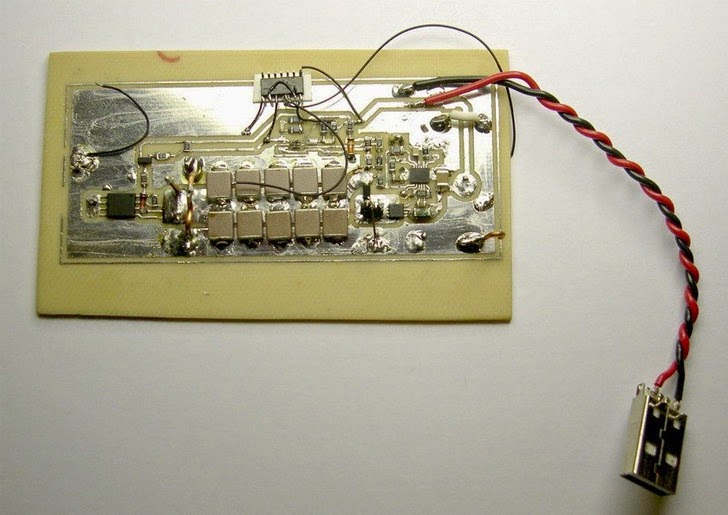


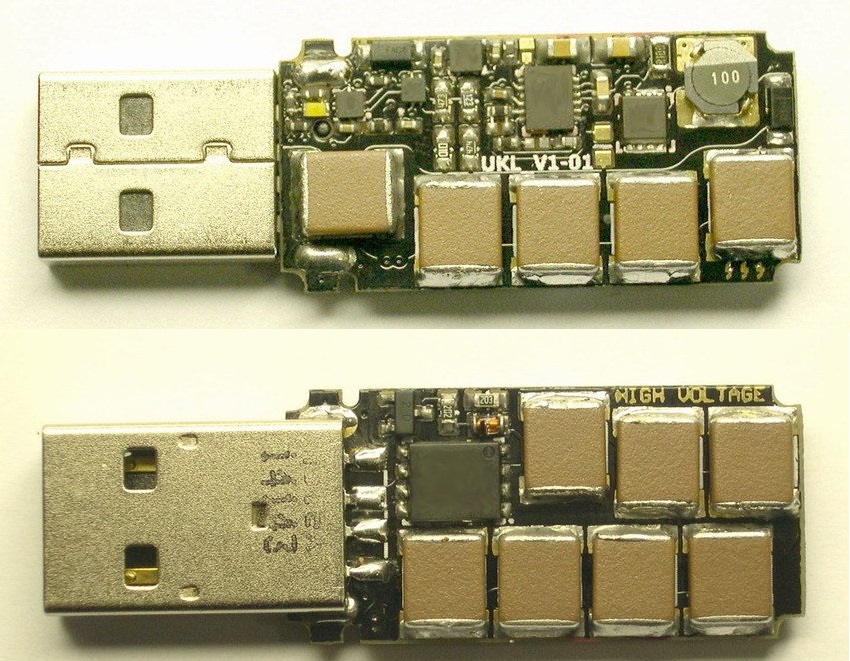
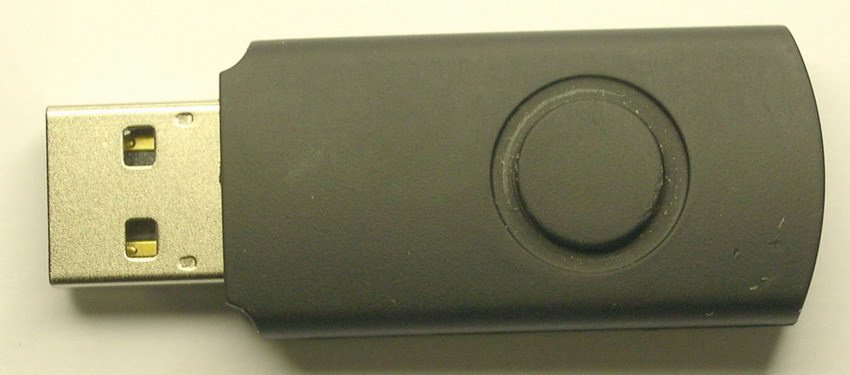
The security expert Dark Purple detailed its experiment for building a weaponized Killer USB device that could be used to burn a machine.

Is it possible to use an apparently USB drive to kill an individual? It seems the scene of a Sci-Fi movie, anyway it is an interesting topic to explore.
Let’s read together the story about Killer USB drive:
A man walking in the subway stole a USB flash drive from the outer pocket of someone else’s bag. The pendrive had “128” written on it. After coming home, he inserted the pendrive into his laptop and instead discovering any useful data, he burnt half of his laptop down. The man then took out the USB pendrive, replaced the text “128” with “129” and put it in the outer pocket of his bag… Amen!
Starting from the story a Russian researcher, nicknamed Dark Purple, developed a proof-of-concept  computer-frying Killer USB pendrive.
Dark Purple works for a company that develops and manufactures electronic components, the researchers together with his colleagues decided to create a USB flash drive which a specific purpose, it “would burn half a laptop down.”
Cool!
The researcher decided to design the Killer USB, a USB flash drive that could be exploited to burn a PC or at least kill its USB port, then, he ordered some circuit boards from China
“I was not going to order the production of printed circuit boards for other projects.”
USB Killer
Basically the researcher wants to charge capacitors to -110V and discharge them. The -110V voltage is applied to the USB interface. The operations go in a loop till everything possible is broken down.
“The basic idea of the USB drive is quite simple. When we connect it up to the USB port, an inverting DC/DC converter runs and charges capacitors to -110V. When the voltage is reached, the DC/DC is switched off. At the same time, the filed transistor opens. It is used to apply the -110V to signal lines of the USB interface. When the voltage on capacitors increases to -7V, the transistor closes and the DC/DC starts. The loop runs till everything possible is broken down. ” said the expert.
The researcher has built a first time killer USB prototype that is able to effectively destroy sensitive components of a computer when plugged-in.
USB Killer 2
Killer USB is not a new concept, weaponized devices could be used to cause malfunction in target systems or to disable defensive systems. USB represents a valid weapon to compromise the system in air-gapped networks.
Let’s think to the Stuxnet case, or the Fanny implant  belonging to the arsenal of the Equation Group APT.
The Fanny worm was considered one of the more interesting weapons in the hacking arsenal of the team, the malware was used by the hackers to map air-gapped networks. The worm was designed to map the topology of a targeted network and to execute commands to these isolated systems by exploiting compromised USB devices.
” For this, it used a unique USB-based command and control mechanism. When a USB stick is infected, Fanny creates a hidden storage area on the stick. If it infects a computer without an internet connection, it will collect basic system information and save it onto the hidden area of the stick. Later, when a stick containing hidden information is plugged into an internet-connected computer infected by Fanny, the data will be scooped up from the hidden area and sent to the C&C. If the attackers want to run commands on the air-gapped networks, they can save these commands in the hidden area of the USB stick. When the stick is plugged into the air-gapped computer, Fanny will recognize the commands and execute them”
“Also in 2014, a security firm demonstrated an attack on Apple’s Mac computer by overriding temperature controls, which can actually set the machine on fire.” reports the colleagues at THEHACKERNEWS that I thanks for publishing the news of the Killer USB.
Lesson learned … before inserting an USB device into your PC, be sure about its origin.


Source:-securityaffairs.co

Killer USB | how to burn a PC with a USB device

The security expert Dark Purple detailed its experiment for building a weaponized Killer USB device that could be used to burn a machine.

Is it possible to use an apparently USB drive to kill an individual? It seems the scene of a Sci-Fi movie, anyway it is an interesting topic to explore.
Let’s read together the story about Killer USB drive:
A man walking in the subway stole a USB flash drive from the outer pocket of someone else’s bag. The pendrive had “128” written on it. After coming home, he inserted the pendrive into his laptop and instead discovering any useful data, he burnt half of his laptop down. The man then took out the USB pendrive, replaced the text “128” with “129” and put it in the outer pocket of his bag… Amen!
Starting from the story a Russian researcher, nicknamed Dark Purple, developed a proof-of-concept  computer-frying Killer USB pendrive.
Dark Purple works for a company that develops and manufactures electronic components, the researchers together with his colleagues decided to create a USB flash drive which a specific purpose, it “would burn half a laptop down.”
Cool!
The researcher decided to design the Killer USB, a USB flash drive that could be exploited to burn a PC or at least kill its USB port, then, he ordered some circuit boards from China
“I was not going to order the production of printed circuit boards for other projects.”
USB Killer
Basically the researcher wants to charge capacitors to -110V and discharge them. The -110V voltage is applied to the USB interface. The operations go in a loop till everything possible is broken down.
“The basic idea of the USB drive is quite simple. When we connect it up to the USB port, an inverting DC/DC converter runs and charges capacitors to -110V. When the voltage is reached, the DC/DC is switched off. At the same time, the filed transistor opens. It is used to apply the -110V to signal lines of the USB interface. When the voltage on capacitors increases to -7V, the transistor closes and the DC/DC starts. The loop runs till everything possible is broken down. ” said the expert.
The researcher has built a first time killer USB prototype that is able to effectively destroy sensitive components of a computer when plugged-in.
USB Killer 2
Killer USB is not a new concept, weaponized devices could be used to cause malfunction in target systems or to disable defensive systems. USB represents a valid weapon to compromise the system in air-gapped networks.
Let’s think to the Stuxnet case, or the Fanny implant  belonging to the arsenal of the Equation Group APT.
The Fanny worm was considered one of the more interesting weapons in the hacking arsenal of the team, the malware was used by the hackers to map air-gapped networks. The worm was designed to map the topology of a targeted network and to execute commands to these isolated systems by exploiting compromised USB devices.
” For this, it used a unique USB-based command and control mechanism. When a USB stick is infected, Fanny creates a hidden storage area on the stick. If it infects a computer without an internet connection, it will collect basic system information and save it onto the hidden area of the stick. Later, when a stick containing hidden information is plugged into an internet-connected computer infected by Fanny, the data will be scooped up from the hidden area and sent to the C&C. If the attackers want to run commands on the air-gapped networks, they can save these commands in the hidden area of the USB stick. When the stick is plugged into the air-gapped computer, Fanny will recognize the commands and execute them”
“Also in 2014, a security firm demonstrated an attack on Apple’s Mac computer by overriding temperature controls, which can actually set the machine on fire.” reports the colleagues at THEHACKERNEWS that I thanks for publishing the news of the Killer USB.
Lesson learned … before inserting an USB device into your PC, be sure about its origin.


Source:-securityaffairs.co


Hack a Computer Only with just a IP Address in Easy steps

Steps to Hack IP Address:

1) Prepare the IP address of the Victim. (e.g : 101.23.53.70 )


2) Download and Install Advanced Port Scanner.
3) Open Advanced Port Scanner and Type the IP Address in the right column and Click Scan.
hack pc, hack with ip

4) It will lists you all Opened Ports of the Victim’s PC or Router. (e.g : Port 91 )
5) After retrieving the IP address and the Opened Ports of the Victim, Open Command Prompt (CMD)
and Type: telnet [IP ADDRESS] [PORT]
e.g : telnet 101.23.53.70  91
6) Now you’ll be asked to Enter Login Information, Just type Username and Password and hit Enter.
If no password is used just type the Username.

Done! Now you’ll get access to all Victim’s Files and Documents by browsing with CMD (use cd, copy, delete, mv… to do all tricks.)


Enjoy :)

Source: learn2crack

Hack a Computer with just a IP Address


Hack a Computer Only with just a IP Address in Easy steps

Steps to Hack IP Address:

1) Prepare the IP address of the Victim. (e.g : 101.23.53.70 )


2) Download and Install Advanced Port Scanner.
3) Open Advanced Port Scanner and Type the IP Address in the right column and Click Scan.
hack pc, hack with ip

4) It will lists you all Opened Ports of the Victim’s PC or Router. (e.g : Port 91 )
5) After retrieving the IP address and the Opened Ports of the Victim, Open Command Prompt (CMD)
and Type: telnet [IP ADDRESS] [PORT]
e.g : telnet 101.23.53.70  91
6) Now you’ll be asked to Enter Login Information, Just type Username and Password and hit Enter.
If no password is used just type the Username.

Done! Now you’ll get access to all Victim’s Files and Documents by browsing with CMD (use cd, copy, delete, mv… to do all tricks.)


Enjoy :)

Source: learn2crack


How i hack a facebook account


The first thing to do is send the letter "F" in an SMS message to Facebook, as though you were legitimately registering your mobile phone with the social network. In the UK, the SMS shortcode for Facebook is 32665.
Send an SMS to Facebook
Facebook responds, via SMS, with an eight character confirmation code.
The normal sequence of events would be to enter that confirmation code into a Facebook form, and go on your merry way...
Facebook mobile activation form
But fin1te discovered that a vulnerability existed on that form, that could be exploited to use the confirmation code he had been sent by Facebook via SMS with *anyone* else's account.
Learn more about security issues on Facebook, and get early warning on scams and scares, by joining thousands of others and liking the Graham Cluley Security News Facebook page today.
What fin1te had uncovered was that one of the elements of the mobile activation form contained, as a parameter, the user's profile ID. That's the unique number associated with your intended target's account.
Profile ID parameter inside form
Change the profile ID that is sent by that form to Facebook, and the social network might be duped into thinking you are someone else linking a mobile phone to their account.
Therefore, the first step needed to hijack someone's account in this way requires your victim's unique Facebook profile ID.
If you don't know what someone's numeric profile ID is, you can always look it up usingfreely-available tools - they aren't supposed to be a secret.
Find a Facebook profile ID
Sure enough, fin1te was able to replace the profile ID parameter sent by his browser to Facebook with the unique number of the account he wanted to access...
Facebook hack data
.. and within seconds his his mobile phone was sent an SMS confirming that he had successfully connected the device to the account.
Facebook confirmation SMS
Success. A Facebook account now has a third-party's mobile phone number associated with it. Without any need for malware or phishing. All that was done was to send an SMS text message.
The final stage of the account hijacking is straightforward. Facebook allows you to log into its system using your mobile number rather than an email address if you want, so at login you enter the mobile phone number you have associated with your victim's account, and request a password reset via SMS.
Facebook password reset code
Sure enough, fin1te discovered that Facebook duly sent him the password reset code for the account - meaning he could change the account's password, and lock out its legitimate user.
This is an incredibly simple but powerful way to take over anybody's Facebook account.
The good news is that fin1te disclosed the vulnerability responsibly to Facebook, rather than exploited it for malicious intentions or sold it to other parties. Facebook has fixed the problem so others can no longer take advantage of this serious security hole. For his troubles, Facebook awarded fin1te a hefty $20,000 worth of bug bounty and fixed the vulnerability.
But there's no doubt that on the underground market, perhaps sold to cybercriminals or intelligence agencies, fin1te's discovery could have earned him even more money.
Who knows what other serious security vulnerabilities may lay inside Facebook that haven't been responsibly reported to the company's security team?
If you are on Facebook, and want to be kept up to date on the latest privacy and security risks threatening users, be sure to Like the "Graham Cluley Security News" Facebook page

Source: grahamcluley 

How i hack a facebook account


How i hack a facebook account


The first thing to do is send the letter "F" in an SMS message to Facebook, as though you were legitimately registering your mobile phone with the social network. In the UK, the SMS shortcode for Facebook is 32665.
Send an SMS to Facebook
Facebook responds, via SMS, with an eight character confirmation code.
The normal sequence of events would be to enter that confirmation code into a Facebook form, and go on your merry way...
Facebook mobile activation form
But fin1te discovered that a vulnerability existed on that form, that could be exploited to use the confirmation code he had been sent by Facebook via SMS with *anyone* else's account.
Learn more about security issues on Facebook, and get early warning on scams and scares, by joining thousands of others and liking the Graham Cluley Security News Facebook page today.
What fin1te had uncovered was that one of the elements of the mobile activation form contained, as a parameter, the user's profile ID. That's the unique number associated with your intended target's account.
Profile ID parameter inside form
Change the profile ID that is sent by that form to Facebook, and the social network might be duped into thinking you are someone else linking a mobile phone to their account.
Therefore, the first step needed to hijack someone's account in this way requires your victim's unique Facebook profile ID.
If you don't know what someone's numeric profile ID is, you can always look it up usingfreely-available tools - they aren't supposed to be a secret.
Find a Facebook profile ID
Sure enough, fin1te was able to replace the profile ID parameter sent by his browser to Facebook with the unique number of the account he wanted to access...
Facebook hack data
.. and within seconds his his mobile phone was sent an SMS confirming that he had successfully connected the device to the account.
Facebook confirmation SMS
Success. A Facebook account now has a third-party's mobile phone number associated with it. Without any need for malware or phishing. All that was done was to send an SMS text message.
The final stage of the account hijacking is straightforward. Facebook allows you to log into its system using your mobile number rather than an email address if you want, so at login you enter the mobile phone number you have associated with your victim's account, and request a password reset via SMS.
Facebook password reset code
Sure enough, fin1te discovered that Facebook duly sent him the password reset code for the account - meaning he could change the account's password, and lock out its legitimate user.
This is an incredibly simple but powerful way to take over anybody's Facebook account.
The good news is that fin1te disclosed the vulnerability responsibly to Facebook, rather than exploited it for malicious intentions or sold it to other parties. Facebook has fixed the problem so others can no longer take advantage of this serious security hole. For his troubles, Facebook awarded fin1te a hefty $20,000 worth of bug bounty and fixed the vulnerability.
But there's no doubt that on the underground market, perhaps sold to cybercriminals or intelligence agencies, fin1te's discovery could have earned him even more money.
Who knows what other serious security vulnerabilities may lay inside Facebook that haven't been responsibly reported to the company's security team?
If you are on Facebook, and want to be kept up to date on the latest privacy and security risks threatening users, be sure to Like the "Graham Cluley Security News" Facebook page

Source: grahamcluley 


ShutterstockIn the world of web where we get the global connectivity, it is far easier to break into someone’s personal zone. By personal, we do not just mean the social media. The world wide web which has become the hub of storing and restoring information, considered to be the safest vault, is a mere toy in the hands of a few computer geniuses. Hackers, Black Hat Hackers, villains, crackers, cyber-criminals, cyber pirates as they are well-known, throw a malicious software or virus at a system to gain the access to the desired information. Piqued by curiosity, they may perhaps break into your system too. Here are top 10 hackers or the whiz kids who put the world in awe with their dexterity.

1. Gary McKinnon


Gary McKinnon must’ve been a curious, restless child, for to gain information on UFOs, he thought it better to get a direct access into the channels of NASA. He infiltrated 97 US military and NASA computers, by installing virus and deleting a few files. All the efforts to satisfy his curiosity, but, alas, curiosity killed the cat. It was soon found that McKinnon was guilty of having hacked the military and NASA websites from his girlfriend’s aunt’s house in London. While entering and deleting the files from these websites wasn’t enough, McKinnon thought of shaming the security forces by putting out a notice on the website that said, “Your security is crap.” Well, looks like McKinnon was something, if he could shut down the US Military’s Washington Network of about 2000 computers for 24 hours, making the hack, the biggest military computer hack of all time!

2. LulzSec

LulzSec or Lulz Security, a high profile, Black Hat hacker group, gained credentials for hacking into Sony, News International, CIA, FBI, Scotland Yard, and several noteworthy accounts. So notorious was the group that when it hacked into News Corporations account, they put across a false report of Rupert Murdoch having passed away. While the group claims to have retired from their vile duties, the motto of the group, “Laughing at your security since 2011!” stays alive. There are assertions of the group having hacked into the websites of the newspapers like The Times and The Sun to post its retirement news. Many, however, claim that this group had taken it upon itself to create awareness about the absence of efficient security against hackers.

3. Adrian Lamo

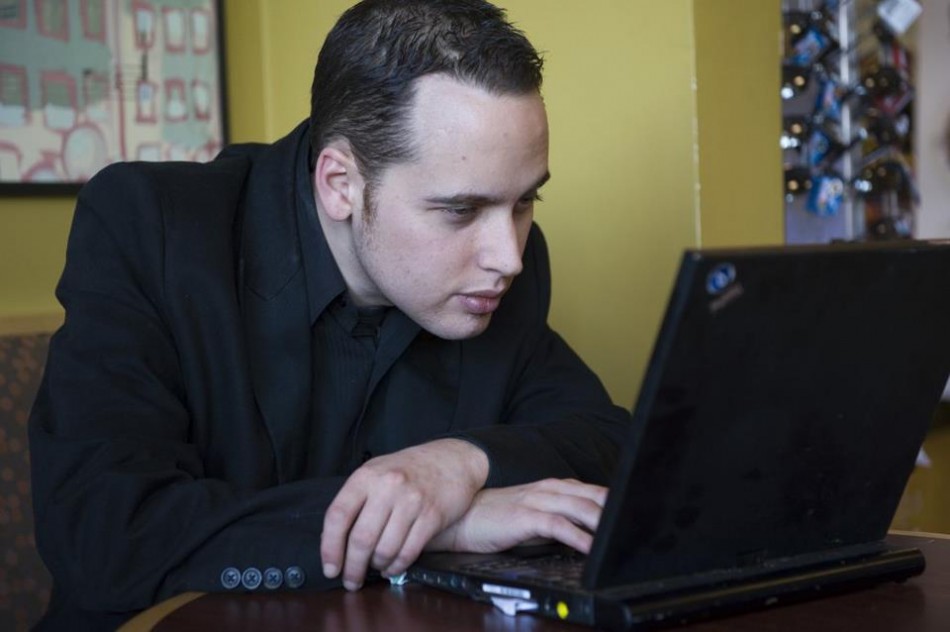
Adrian Lamo decided to switch careers when he realized the potentials of his skills. He became a news when he hacked into Yahoo!, Microsoft, Google, and The New York Times. This, although culminated into his arrest, it later helped him gain the batch of an American Threat Analyst. A guy who would hack into top-notch accounts sitting in the spacious and comforting cafeterias, libraries, internet cafes, soon turned Wikileaks suspect Bradley Manning over to FBI. While Manning was arrested for leaking several hundred sensitive US government documents, Lamo went hiding or should we presume, undercover?

4. Mathew Bevan and Richard Pryce


Targeting the over-sensitive nerves, what Mathew Bevan along with his alleged partner Richard Pryce did, could have triggered great many issues between USA and North Korea. The duo hacked the US military computers and used it as a means to infiltrate the foreign systems. The crucial contents of Korean Atomic Research Institute were dumped into USAF system. However, the contents were majorly relevant to South Korea and hence, less volatile. But this, nonetheless, could have led to a huge international issue.

5. Jonathan James

The first juvenile to be imprisoned for a cyber-crime at the age of 16, Jonathan James or better known as c0mrade, hacked into Defense Threat Reduction Agency of US department. Further, he installed a sniffer that scrutinized the messages passed on between the DTRA employees. Not only did he keep a check on the messages being passed around, in the process, he collected the passwords and usernames and other such vital details of the employees, and further even stole essential software. All this cost NASA to shut down its system and to pay from its pocket $41,000. c0mrade, however, had a bitter ending as James committed suicide in 2008.

6. Kevin Poulsen

How far would you go to win your dream car or a dream house? How far will you go to win an online contest or a radio show contest? Perhaps, you shall keep trying your luck, unless you are Kevin Poulsen! Poulsen infiltrated a radio shows call-in contest just so he could win a Porsche. Dark Dante, as he was better known, went underground after FBI started pursuing him. He, later, was found guilty of seven counts of mail, wire and computer fraud, money laundering and the likes. What turned out to be rewarding in Dark Dante’s case is – his past crafted his future. Poulsen now serves as a Senior Editor at Wired.

7. Kevin Mitnick

Clad in an Armani suit, when a bespectacled face in his mid-40s smiles at you from the computer screen, you can hardly consider the man a cyber-criminal. Such is the case with Kevin David Mitnick. Once upon a time, the most wanted cyber-criminal of US, now is an affluent entrepreneur. Kevin, who is now a security consultant, was convicted of hacking Nokia, Motorola and Pentagon. He pleaded guilty to seven counts of fraud that included wire fraud, computer fraud and of illegally interception a wire communication. After five years of incarceration that included eight months of solitary confinement, Mitnick now has started afresh. However, his knack with the computers is still reminisced and was even depicted on celluloid in the films Takedown and Freedom Downtown.


8. Anonymous


The concept of being a “digital Robin Hood” was far from being conceived, but in the computer age, it is very likely that someone somewhere has bagged this title. A “hacktivist group” called Anonymous are known with the penname of being the “digital Robin Hood” amongst its supporters. Identified in public by wearing a Guy Fawkes Masks, Anons, as they are widely known, have publicized themselves by attacking the government, religious and corporate websites. The Vatican, the FBI, the CIA, PayPal, Sony, Mastercard, Visa, Chinese, Israeli, Tunisian, and Ugandan governments have been amongst their targets. Although, Anons have been arguing whether to engage in a serious activism or a mere entertainment, many of the group members have clarified their intent which is to attack internet censorship and control.

9. Astra

Astra, a Sanskrit word for weapon was the penname of a hacker who dealt in the weapon stealing and selling. A 58-year-old Greek Mathematician hacked into the systems of France’s Dassault Group, stole vulnerable weapons technology data and sold it to different countries for five long years. While the real identity of the ASTRA remains untraced, officials have said that he had been wanted since 2002. Astra sold the data to approximately 250 people from around the globe, which cost Dassault $360 millions of damage.

10. Albert Gonzalez


How safe is internet banking? When we browse through the profile of this mastermind, we are certain that one ought to use the World Wide Web with immense care. For two long years, Albert Gonzalez, stole from credit cards of the netizens. This was recorded to be the biggest credit card theft in the history of mankind. He resold approximately 170 million credit cards and ATM numbers. He did so by installing a sniffer and sniffing out the computer data from internal corporate networks. When arrested, Gonzalez was sentenced to 20 years in Federal prison.

10 Best Hackers The World Has Ever Known


ShutterstockIn the world of web where we get the global connectivity, it is far easier to break into someone’s personal zone. By personal, we do not just mean the social media. The world wide web which has become the hub of storing and restoring information, considered to be the safest vault, is a mere toy in the hands of a few computer geniuses. Hackers, Black Hat Hackers, villains, crackers, cyber-criminals, cyber pirates as they are well-known, throw a malicious software or virus at a system to gain the access to the desired information. Piqued by curiosity, they may perhaps break into your system too. Here are top 10 hackers or the whiz kids who put the world in awe with their dexterity.

1. Gary McKinnon


Gary McKinnon must’ve been a curious, restless child, for to gain information on UFOs, he thought it better to get a direct access into the channels of NASA. He infiltrated 97 US military and NASA computers, by installing virus and deleting a few files. All the efforts to satisfy his curiosity, but, alas, curiosity killed the cat. It was soon found that McKinnon was guilty of having hacked the military and NASA websites from his girlfriend’s aunt’s house in London. While entering and deleting the files from these websites wasn’t enough, McKinnon thought of shaming the security forces by putting out a notice on the website that said, “Your security is crap.” Well, looks like McKinnon was something, if he could shut down the US Military’s Washington Network of about 2000 computers for 24 hours, making the hack, the biggest military computer hack of all time!

2. LulzSec

LulzSec or Lulz Security, a high profile, Black Hat hacker group, gained credentials for hacking into Sony, News International, CIA, FBI, Scotland Yard, and several noteworthy accounts. So notorious was the group that when it hacked into News Corporations account, they put across a false report of Rupert Murdoch having passed away. While the group claims to have retired from their vile duties, the motto of the group, “Laughing at your security since 2011!” stays alive. There are assertions of the group having hacked into the websites of the newspapers like The Times and The Sun to post its retirement news. Many, however, claim that this group had taken it upon itself to create awareness about the absence of efficient security against hackers.

3. Adrian Lamo

Adrian Lamo decided to switch careers when he realized the potentials of his skills. He became a news when he hacked into Yahoo!, Microsoft, Google, and The New York Times. This, although culminated into his arrest, it later helped him gain the batch of an American Threat Analyst. A guy who would hack into top-notch accounts sitting in the spacious and comforting cafeterias, libraries, internet cafes, soon turned Wikileaks suspect Bradley Manning over to FBI. While Manning was arrested for leaking several hundred sensitive US government documents, Lamo went hiding or should we presume, undercover?

4. Mathew Bevan and Richard Pryce


Targeting the over-sensitive nerves, what Mathew Bevan along with his alleged partner Richard Pryce did, could have triggered great many issues between USA and North Korea. The duo hacked the US military computers and used it as a means to infiltrate the foreign systems. The crucial contents of Korean Atomic Research Institute were dumped into USAF system. However, the contents were majorly relevant to South Korea and hence, less volatile. But this, nonetheless, could have led to a huge international issue.

5. Jonathan James

The first juvenile to be imprisoned for a cyber-crime at the age of 16, Jonathan James or better known as c0mrade, hacked into Defense Threat Reduction Agency of US department. Further, he installed a sniffer that scrutinized the messages passed on between the DTRA employees. Not only did he keep a check on the messages being passed around, in the process, he collected the passwords and usernames and other such vital details of the employees, and further even stole essential software. All this cost NASA to shut down its system and to pay from its pocket $41,000. c0mrade, however, had a bitter ending as James committed suicide in 2008.

6. Kevin Poulsen

How far would you go to win your dream car or a dream house? How far will you go to win an online contest or a radio show contest? Perhaps, you shall keep trying your luck, unless you are Kevin Poulsen! Poulsen infiltrated a radio shows call-in contest just so he could win a Porsche. Dark Dante, as he was better known, went underground after FBI started pursuing him. He, later, was found guilty of seven counts of mail, wire and computer fraud, money laundering and the likes. What turned out to be rewarding in Dark Dante’s case is – his past crafted his future. Poulsen now serves as a Senior Editor at Wired.

7. Kevin Mitnick

Clad in an Armani suit, when a bespectacled face in his mid-40s smiles at you from the computer screen, you can hardly consider the man a cyber-criminal. Such is the case with Kevin David Mitnick. Once upon a time, the most wanted cyber-criminal of US, now is an affluent entrepreneur. Kevin, who is now a security consultant, was convicted of hacking Nokia, Motorola and Pentagon. He pleaded guilty to seven counts of fraud that included wire fraud, computer fraud and of illegally interception a wire communication. After five years of incarceration that included eight months of solitary confinement, Mitnick now has started afresh. However, his knack with the computers is still reminisced and was even depicted on celluloid in the films Takedown and Freedom Downtown.


8. Anonymous


The concept of being a “digital Robin Hood” was far from being conceived, but in the computer age, it is very likely that someone somewhere has bagged this title. A “hacktivist group” called Anonymous are known with the penname of being the “digital Robin Hood” amongst its supporters. Identified in public by wearing a Guy Fawkes Masks, Anons, as they are widely known, have publicized themselves by attacking the government, religious and corporate websites. The Vatican, the FBI, the CIA, PayPal, Sony, Mastercard, Visa, Chinese, Israeli, Tunisian, and Ugandan governments have been amongst their targets. Although, Anons have been arguing whether to engage in a serious activism or a mere entertainment, many of the group members have clarified their intent which is to attack internet censorship and control.

9. Astra

Astra, a Sanskrit word for weapon was the penname of a hacker who dealt in the weapon stealing and selling. A 58-year-old Greek Mathematician hacked into the systems of France’s Dassault Group, stole vulnerable weapons technology data and sold it to different countries for five long years. While the real identity of the ASTRA remains untraced, officials have said that he had been wanted since 2002. Astra sold the data to approximately 250 people from around the globe, which cost Dassault $360 millions of damage.

10. Albert Gonzalez


How safe is internet banking? When we browse through the profile of this mastermind, we are certain that one ought to use the World Wide Web with immense care. For two long years, Albert Gonzalez, stole from credit cards of the netizens. This was recorded to be the biggest credit card theft in the history of mankind. He resold approximately 170 million credit cards and ATM numbers. He did so by installing a sniffer and sniffing out the computer data from internal corporate networks. When arrested, Gonzalez was sentenced to 20 years in Federal prison.


A number of you have written me regarding which operating system is best for hacking. I'll start by saying that nearly every professional and expert hacker uses Linux or Unix. Although some hacks can be done with Windows and Mac OS, nearly all of the hacking tools are developed specifically for Linux.


There are some exceptions, though, including software like Cain and Abel, Havij, Zenmap, and Metasploit that are developed or ported for Windows.
When these Linux apps are developed in Linux and then ported over to Windows, they often lose some of their capabilities. In addition, there are capabilities built into Linux that simply are not available in Windows. That is why hacker tools are in most cases ONLY developed for Linux.
To summarize, to be a real expert hacker, you should master a few Linux skills and work from a Linux distribution like BackTrack or Kali.
Image via wonderhowto.com
For those of you who've never used Linux, I dedicate the next few tutorials on the basics of Linux with an emphasis on the skills you need for hacking. So, let's open up BackTrack or your other Linux distribution and let me show you a few things.

Step 1: Boot Up Linux

Once you've booted up BackTrack, logged in as "root" and then type:
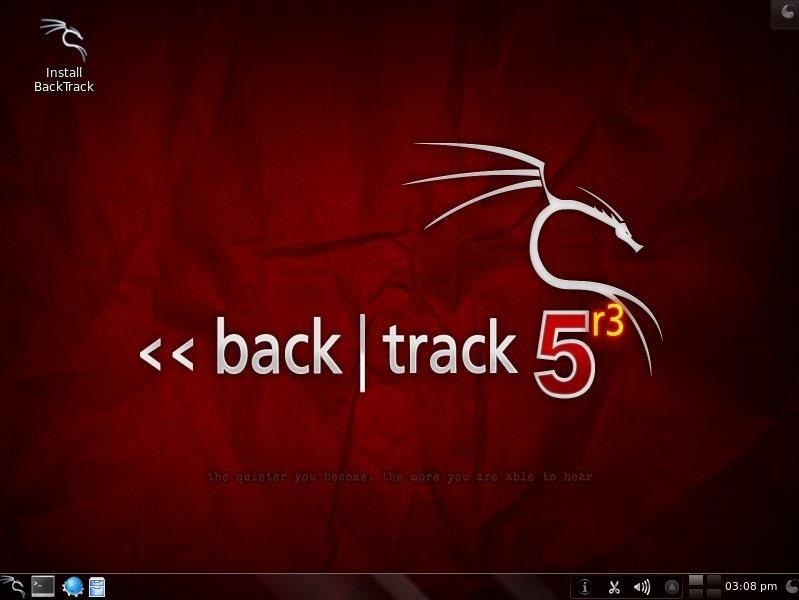
  • bt > startx
You should have a screen that looks similar to this.

Step 2: Open a Terminal

To become proficient in Linux, you MUST master the terminal. Many things can be done now in the various Linux distributions by simply pointing and clicking, similar to Windows or Mac OS, but the expert hacker must know how to use the terminal to run most of the hacking tools.
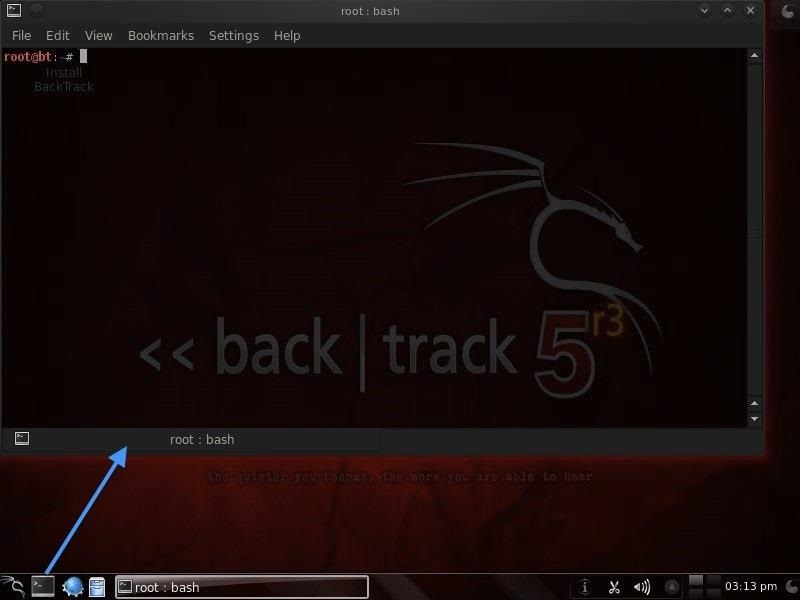
So, let's open a terminal by clicking on the terminal icon on the bottom bar. That should give us a screen that looks similar to this.
If you've ever used the command prompt in Windows, the Linux terminal is similar, but far more powerful. Unlike the Windows command prompt, you can do EVERYTHING in Linux from the terminal and control it more precisely than in Windows.
It's important to keep in mind that unlike Windows, Linux is case-sensitive. This means that "Desktop" is different from "desktop" which is different from "DeskTop". Those who are new to Linux often find this challenging, so try to keep this in mind.

Step 3: Examine the Directory Structure

Let's start with some basic Linux. Many beginners get tripped up by the structure of the file system in Linux. Unlike Windows, Linux's file system is not linked to a physical drive like in Windows, so we don't have a c:\ at the beginning of our Linux file system, but rather a /.
The forward slash (/) represents the "root" of the file system or the very top of the file system. All other directories (folders) are beneath this directory just like folders and sub-folders are beneath the c:\ drive.
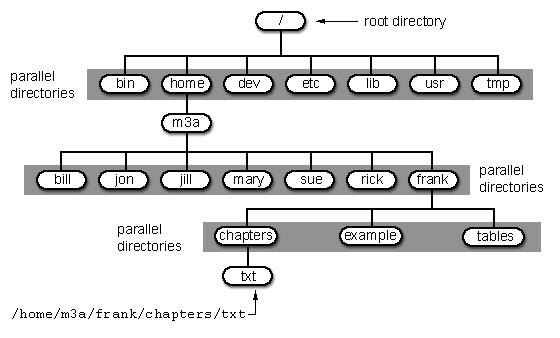
To visualize the file system, let's take a look at this diagram below.
It's important to have a basic understanding of this file structure because often we need to navigate through it from the terminal without the use of a graphical tool like Windows Explorer.
A couple key things to note in this graphical representation:
  • The /bin directory is where binaries are stored. These are the programs that make Linux run.
  • /etc is generally where the configuration files are stored. In Linux, nearly everything is configured with a text file that is stored under /etc.
  • /dev directory holds device files, similar to Windows device drivers.
  • /var is generally where log files, among other files, are stored.

Step 4: Using Pwd

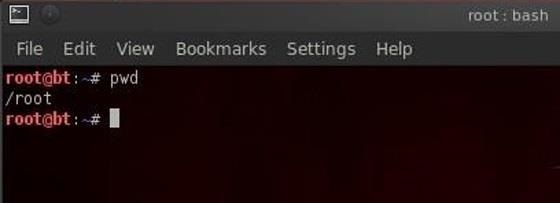
When we open a terminal in BackTrack, the default directory we're in is our "home" directory. As you can see from the graphic above, it's to the right of the "root" directory or one level "below" root. We can confirm what directory we are in by typing:
  • bt > pwd
pwd stands for "present working directory" and as you can see, it returns "/root" meaning we're in the root users directory (don't confuse this with the top of the directory tree "root." This is the root users directory).
pwd is a handy command to remember as we can use it any time to tell us where we are in the directory tree.

Step 5: Using Cd Command

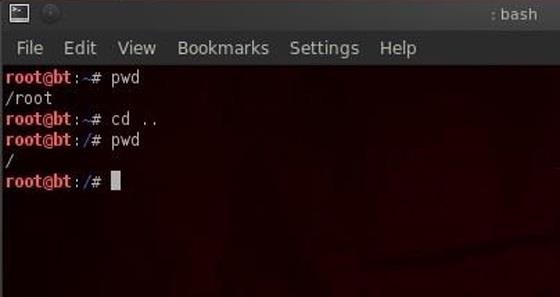
We can change the directory we're working in by using the cd (change directory) command. In this case, let's navigate "up" to the top of the directory structure by typing:
  • bt > cd ..
The cd command followed by the double dots (..) says, "move me up one level in the directory tree." Notice that our command prompt has changed and when we type pwd we see that Linux responds by telling us we are in the "/" or the top of the directory tree (or the root directory).
  • bt > pwd

Step 6: Using the Whoami Command

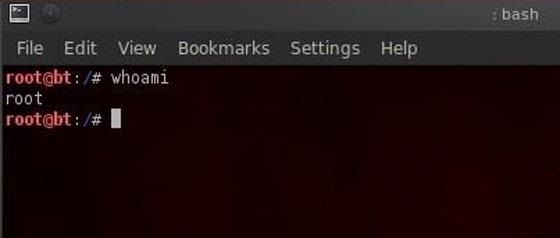
In our last lesson of this tutorial, we'll use the whoami command. This command will return the name of the user we're logged in as. Since we're the root user, we can log in to any user account and that user's name would be displayed here.
  • bt > whoami
That's it for now. In the next several tutorials, I will continue to give you the basics of Linux that you'll need to be a pro hacker, so keep coming back!

Source: null-byte.wonderhowto

Work with Terminal Linux


A number of you have written me regarding which operating system is best for hacking. I'll start by saying that nearly every professional and expert hacker uses Linux or Unix. Although some hacks can be done with Windows and Mac OS, nearly all of the hacking tools are developed specifically for Linux.


There are some exceptions, though, including software like Cain and Abel, Havij, Zenmap, and Metasploit that are developed or ported for Windows.
When these Linux apps are developed in Linux and then ported over to Windows, they often lose some of their capabilities. In addition, there are capabilities built into Linux that simply are not available in Windows. That is why hacker tools are in most cases ONLY developed for Linux.
To summarize, to be a real expert hacker, you should master a few Linux skills and work from a Linux distribution like BackTrack or Kali.
Image via wonderhowto.com
For those of you who've never used Linux, I dedicate the next few tutorials on the basics of Linux with an emphasis on the skills you need for hacking. So, let's open up BackTrack or your other Linux distribution and let me show you a few things.

Step 1: Boot Up Linux

Once you've booted up BackTrack, logged in as "root" and then type:
  • bt > startx
You should have a screen that looks similar to this.

Step 2: Open a Terminal

To become proficient in Linux, you MUST master the terminal. Many things can be done now in the various Linux distributions by simply pointing and clicking, similar to Windows or Mac OS, but the expert hacker must know how to use the terminal to run most of the hacking tools.
So, let's open a terminal by clicking on the terminal icon on the bottom bar. That should give us a screen that looks similar to this.
If you've ever used the command prompt in Windows, the Linux terminal is similar, but far more powerful. Unlike the Windows command prompt, you can do EVERYTHING in Linux from the terminal and control it more precisely than in Windows.
It's important to keep in mind that unlike Windows, Linux is case-sensitive. This means that "Desktop" is different from "desktop" which is different from "DeskTop". Those who are new to Linux often find this challenging, so try to keep this in mind.

Step 3: Examine the Directory Structure

Let's start with some basic Linux. Many beginners get tripped up by the structure of the file system in Linux. Unlike Windows, Linux's file system is not linked to a physical drive like in Windows, so we don't have a c:\ at the beginning of our Linux file system, but rather a /.
The forward slash (/) represents the "root" of the file system or the very top of the file system. All other directories (folders) are beneath this directory just like folders and sub-folders are beneath the c:\ drive.
To visualize the file system, let's take a look at this diagram below.
It's important to have a basic understanding of this file structure because often we need to navigate through it from the terminal without the use of a graphical tool like Windows Explorer.
A couple key things to note in this graphical representation:
  • The /bin directory is where binaries are stored. These are the programs that make Linux run.
  • /etc is generally where the configuration files are stored. In Linux, nearly everything is configured with a text file that is stored under /etc.
  • /dev directory holds device files, similar to Windows device drivers.
  • /var is generally where log files, among other files, are stored.

Step 4: Using Pwd

When we open a terminal in BackTrack, the default directory we're in is our "home" directory. As you can see from the graphic above, it's to the right of the "root" directory or one level "below" root. We can confirm what directory we are in by typing:
  • bt > pwd
pwd stands for "present working directory" and as you can see, it returns "/root" meaning we're in the root users directory (don't confuse this with the top of the directory tree "root." This is the root users directory).
pwd is a handy command to remember as we can use it any time to tell us where we are in the directory tree.

Step 5: Using Cd Command

We can change the directory we're working in by using the cd (change directory) command. In this case, let's navigate "up" to the top of the directory structure by typing:
  • bt > cd ..
The cd command followed by the double dots (..) says, "move me up one level in the directory tree." Notice that our command prompt has changed and when we type pwd we see that Linux responds by telling us we are in the "/" or the top of the directory tree (or the root directory).
  • bt > pwd

Step 6: Using the Whoami Command

In our last lesson of this tutorial, we'll use the whoami command. This command will return the name of the user we're logged in as. Since we're the root user, we can log in to any user account and that user's name would be displayed here.
  • bt > whoami
That's it for now. In the next several tutorials, I will continue to give you the basics of Linux that you'll need to be a pro hacker, so keep coming back!

Source: null-byte.wonderhowto